Accountability
How to hold yourself accountable when you work alone

To hold yourself accountable when you work alone, make a specific commitment, decide when you will review it, and record what happened. Include a recovery step for a missed session. A vague promise to work harder gives you little to review at the end of the day.
Start with one piece of work that matters to the business. If you are trying to get your first customer, “finish and send three relevant outreach messages by Thursday” is easier to check than “be more productive.”
Give the commitment a place in the week
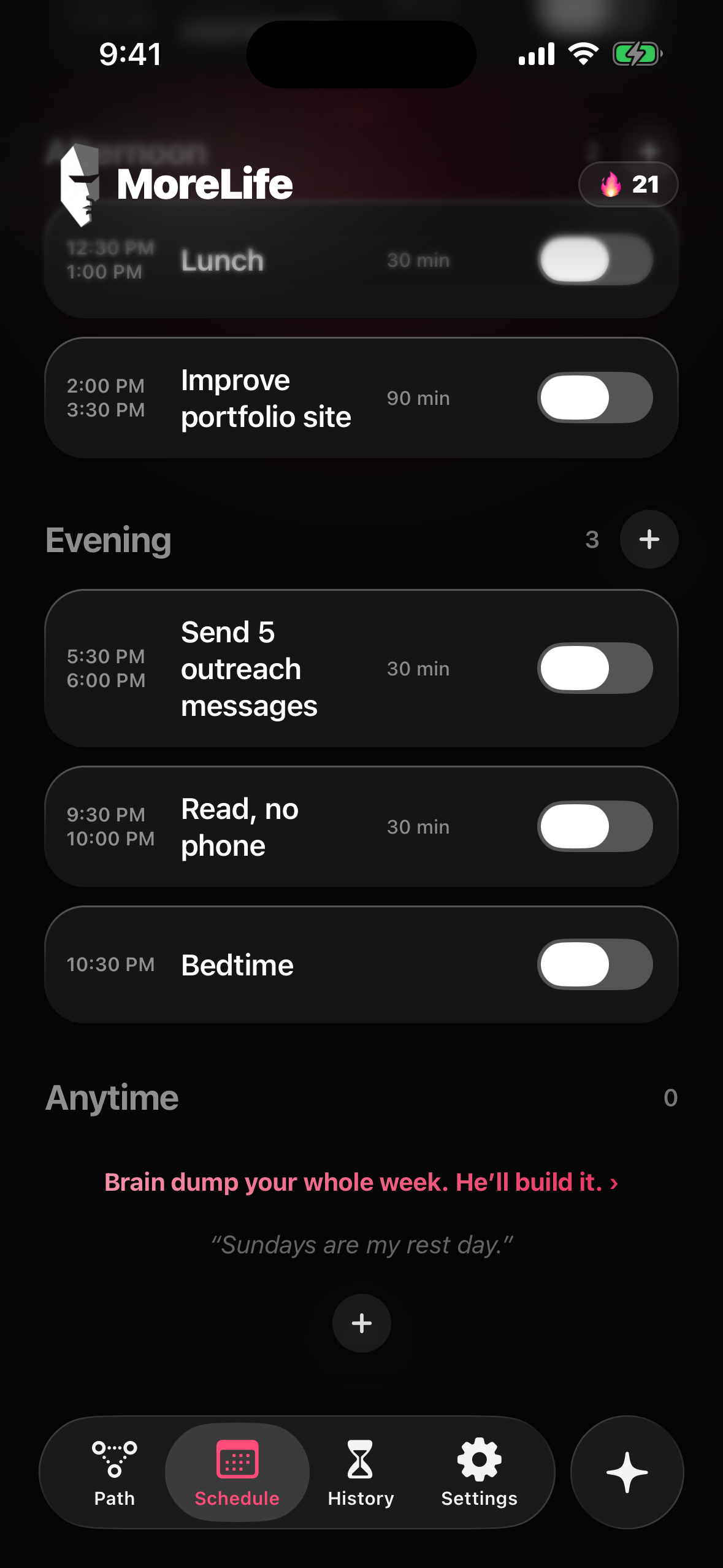
Choose an available work window and a task that fits it. Include your existing responsibilities before adding business sessions. If you are balancing school, a job, or training, use a realistic weekly schedule as a starting point.
Decide the next action before you sit down. “Open the laptop” can help you start, but “finish the first relevant message” gives you an output to review.
Arrange a specific review
You can review the work in a notebook, share it with a willing partner, or use a coaching tool. If another person is involved, agree on what you will share and when. They need to accept the arrangement rather than simply receive a stream of updates they did not ask for.
MoreLife brings an AI coach, a plan, and check-ins into one workflow for ambitious young men. The point of the review is to make the next action clearer, including on a day when the work did not happen.
A check-in you can use tonight
| Question | Example |
|---|---|
| What did I commit to? | Finish three relevant messages during the 6:30 session |
| What happened? | Finished one; spent the rest of the time changing the offer |
| What got in the way? | I had not decided which service I was offering |
| What is the next action? | Choose the offer before tomorrow's session, then finish the remaining two messages |
| When will I check again? | Tomorrow at 7:15 |
This is an illustration, not a customer result. Replace the examples with your own commitment and record what happened in ordinary language. “The assignment ran late” or “I had not chosen the offer” gives you something you can address.
If you miss the session
Reschedule the unfinished task into an actual available window. If you keep missing the same slot, reduce the task or choose a different time. Avoid promising twice as much tomorrow when tomorrow is already full.
If one missed session keeps turning into abandoning the week, decide a recovery rule in advance. For example: “If I miss Tuesday, I will use the available thirty-minute slot on Thursday for the same task.” Read more about returning after the initial motivation fades.
Review the work as well as the follow-through
If you complete the tasks but they do not produce useful evidence or progress, review the work itself. “I did not contact the customers” and “I contacted suitable customers and heard that the offer was not useful” call for different decisions.
The review should help you notice both. Accountability does not require defending a business idea forever. If you keep switching before doing a useful test, try this process for choosing one idea and testing it.
Choose support that fits the sticking point
A live coworking session may suit someone who needs an appointment to begin. A willing partner can discuss the commitment. An AI coach can offer conversational support around a plan. A simple notebook may be enough to make the work visible to you.
Compare those options in the accountability app guide, or read what an AI accountability coach does. Start with one commitment and one review time, then judge the arrangement by what happens during the week.
You already know what you're supposed to do today.
MoreLife is the one that asks whether you did it.