Accountability
Why do I get motivated for a week and then quit?

On Sunday, you decide this is the week you change things. You make a schedule, choose a business idea, and promise yourself you will work every night. A few days later, the work feels ordinary. You miss a session. By the following Sunday, you are making another plan.
One possibility is that your plan only works while you feel excited about it. Look at the moment you stopped: was the task too large, was the next step unclear, did something else take the time, or did one missed day turn into dropping the whole plan? The answer tells you what to change.
Find the first point where the plan broke
Use your last attempt, not an imaginary perfect week. Write down the first session you missed and what happened immediately before it.
| What happened | A change to test |
|---|---|
| You planned three hours after an already full day | Choose a shorter session you can realistically fit |
| You opened the laptop and did not know what to do | Name the next concrete task before the session starts |
| You checked your phone and never began | Put the phone out of reach for the first work block |
| You sent messages, got no replies, and abandoned the idea | Set a review date and examine the offer, audience, and responses |
| You missed Tuesday and wrote off the week | Choose the next available session and resume there |
These are different problems. A more intense promise to yourself does not resolve all of them.
Set a normal-day commitment and a fallback
Suppose you are trying to get the first customer for a small service business. Your normal session might be forty minutes spent finding suitable prospects and writing relevant messages. Your fallback could be finishing one message.
The fallback should still produce something useful. Opening the laptop is a start, but it does not tell you whether the work moved forward.
Choose the fallback before you are tired. Then use it as a way to keep the next step manageable, not as an obligation to work through illness or a genuinely overloaded day.
Decide how you will return after a miss
You do not need another Monday to restart.
Write a simple recovery instruction: “If I miss the Tuesday session, I will use the available thirty-minute window on Thursday to complete the same task.” Check that the window exists. A promise to do twice as much tomorrow can make the next day harder to start.
Record the reason for the miss in ordinary language. “The assignment ran late” is more useful than “I have no discipline.” One points to a scheduling problem you can adjust.
Give the work a fair review
Staying consistent does not mean keeping a bad approach forever. If you are testing a business idea, decide what evidence you need and when you will review it. Separate the work you completed from what the market told you.
“I did not do the outreach” and “I completed the outreach and the people I contacted did not need the offer” call for different next steps. The first asks you to examine execution. The second asks you to examine the offer or the test.
Make the check-in specific
A useful check-in asks: what did you plan, what happened, and what is the next action? You can do it in a notebook, with a friend, or through an accountability tool.
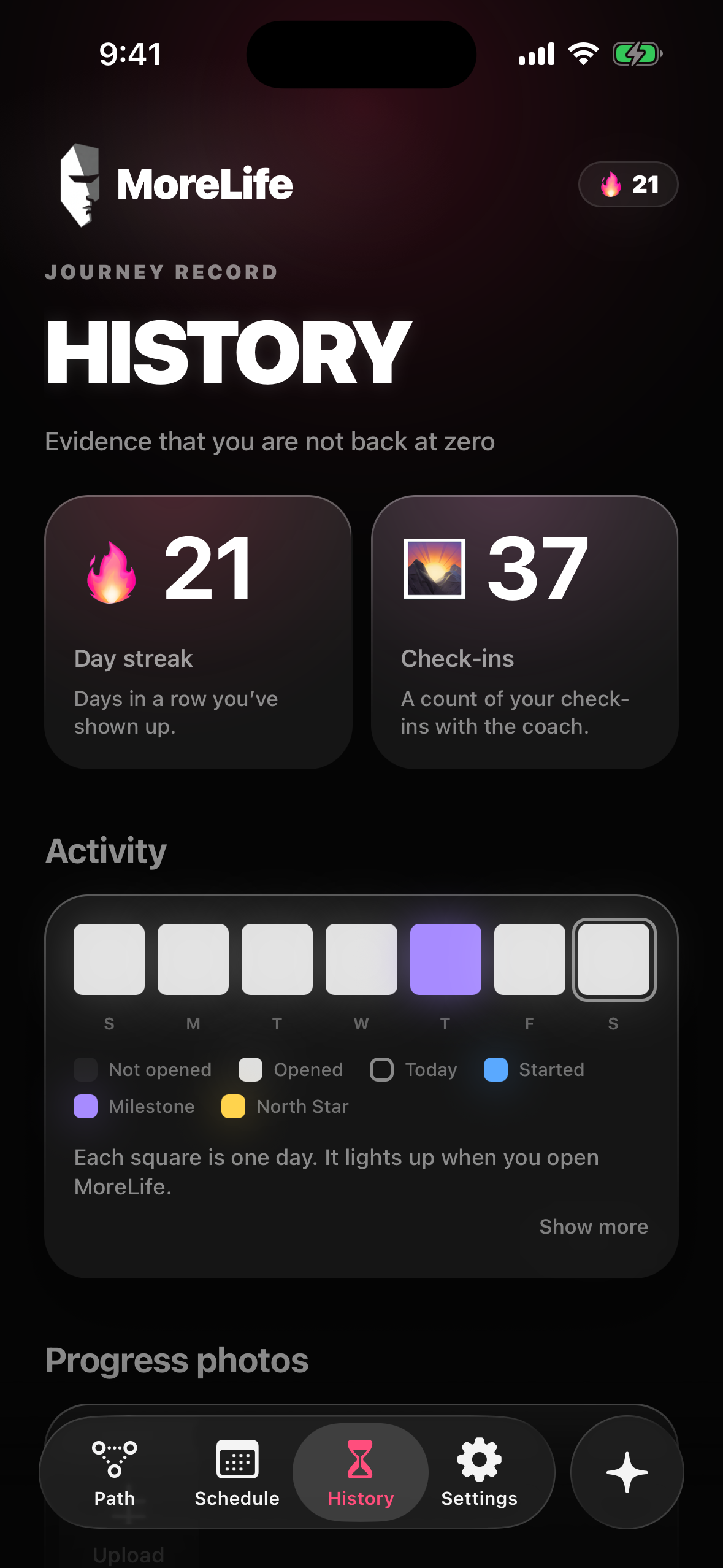
MoreLife is built for young men who want an AI coach alongside their plan and daily check-ins. If you keep losing the connection between the goal and today's work, that is the problem it aims to help with. It does not remove the work or guarantee that a business idea will succeed.
For the next week, test one smaller commitment and one recovery rule. At the end, look at what you actually completed before deciding whether to add more.
Keep going
If the schedule itself is overloaded, start with balancing school, gym, and business work. If you keep replacing the goal, try a small test before switching business ideas.
You already know what you're supposed to do today.
MoreLife is the one that asks whether you did it.